Solar power has transformed from a niche technology into a global energy giant. By 2024, solar provided around 7% of the world’s electricity supply, with installed capacity surpassing 1.6 terawatts. But how exactly do those sleek panels on rooftops and sprawling solar farms stretching across landscapes turn sunlight into the electricity powering your devices?
This guide breaks down everything you need to know about how solar panels generate electricity, from the basic physics to grid integration and beyond.
Quick answer: how solar power generates electricity
Solar panels work by converting light energy from the sun into electrical energy through a process called the photovoltaic effect. When sunlight strikes the photovoltaic cells inside a panel, it excites electrons in the semiconductor material (usually silicon), creating an electric current. An inverter then converts this into the type of electricity your home can use.
Here’s the five-step journey in simple terms: (1) sunlight hits solar panels, exciting electrons in the pv cells, (2) panels produce low-voltage dc electricity, (3) a solar inverter converts this dc electricity to ac electricity at 230V and 50Hz, (4) the alternating current flows to your consumer unit to power appliances, and (5) any extra energy either charges a solar battery for later use or gets exported to the national grid.
As of 2024, solar electricity contributed roughly 7% of global power generation. That percentage continues climbing as costs fall and more countries commit to clean energy targets. For many homeowners and businesses, understanding this process is the first step toward making informed decisions about energy production on their own properties.
What is solar power and solar energy?
Solar energy refers to the radiant energy emitted by the Sun, arriving at earth’s surface primarily as visible light, ultraviolet, and infrared rays. Solar power, meanwhile, specifically describes the technologies that capture the sun’s energy and convert it into usable electricity or heat.
The distinction matters. Solar energy is the raw resource, originating from nuclear fusion in the Sun’s core and travelling approximately 150 million kilometres to reach us in about 8 minutes and 20 seconds. Solar power encompasses the practical systems we use to harness this resource, from rooftop installations on homes in cloudy London to vast solar parks in sun-drenched Spain producing gigawatts for national grids.
Where do we actually see solar power systems in action today? The applications span an impressive range. Residential rooftops offset household electricity bills. Commercial buildings reduce operational costs. Remote telecom towers in off-grid areas rely on panels to power base stations for years without fuel deliveries. Satellites like the International Space Station generate kilowatts from orbital sunlight. Even low-power electronic devices such as calculators have used solar cells since the 1970s.
Solar power qualifies as a renewable energy source because the Sun will continue shining for at least another 5 billion years. During operation, solar energy systems emit no greenhouse gases or pollutants since no fuel combustion occurs. The lifecycle emissions typically run around 40-50 grams of CO₂ per kilowatt-hour, far below coal’s 800-1000 g/kWh or natural gas’s 400-500 g/kWh.
How do solar panels generate electricity? (step-by-step)
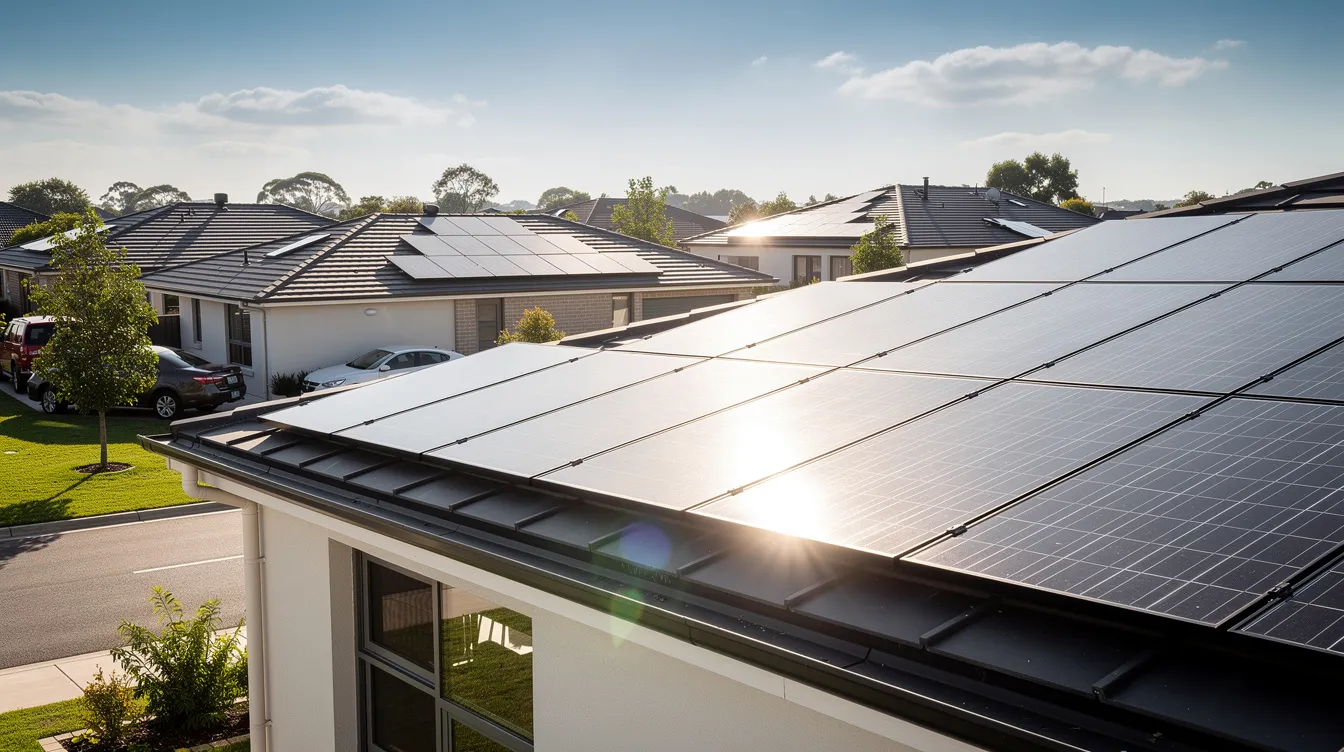
Most modern solar panel systems employ crystalline silicon photovoltaic cells to convert sunlight directly into direct current. Understanding how this works requires looking at the construction of individual solar panels and the physics happening at the atomic level.
A typical solar cell consists of two layers of silicon semiconductor material. The top layer, called n-type silicon, is infused with phosphorus atoms that provide extra electrons. The bottom layer, p-type silicon, is doped with boron, creating electron deficiencies (called “holes”). Where these two layers meet forms a p-n junction with a built-in electric field.
When photons from sunlight strike the silicon with sufficient energy (above the bandgap of about 1.1 electronvolts), they knock electrons loose from their atoms. The electric field at the junction sweeps these freed electrons toward the n-side while pushing holes to the p-side. Metal contacts on the cell (thin “fingers” and larger “busbars”) collect these electrons, and when connected in a circuit, they flow as direct current, generating a voltage of around 0.5-0.6V per cell.
The path from sunlight to usable power output follows a clear progression. Energy generated in individual solar cells (typically 60-72 per module, producing 300-450W collectively) flows through internal wiring in series-parallel configurations to form a solar panel. Multiple individual solar panels connect in strings to form a solar array. DC cabling then channels this electricity to a central inverter, which outputs ac electricity to the building’s switchboard for distribution to appliances.
For a concrete UK example, consider a standard 4 kWp solar pv system on a south facing roof at a 30-degree tilt. Under typical English weather conditions (average 900-1100 kWh/m²/year irradiance), this system generates roughly 3,500-4,500 kWh annually. That’s enough to cover over 80% of an average household’s 4,200 kWh/year consumption, significantly reducing reliance on grid electricity and cutting electricity bills substantially.
From DC to AC: the role of the inverter
Homes and electrical grids operate on alternating current at standardised frequencies because AC transmits efficiently over long distances with minimal losses via transformers. Since solar panels inherently produce electricity as dc electricity, inverters serve as the critical bridge in any grid-connected solar pv system.
A solar inverter takes low-voltage DC (often 200-1000V from panel strings) and converts it to 230V single-phase ac electricity for homes or 400V three-phase for larger setups. Modern inverters synchronise phase, voltage, and frequency precisely with the national grid while using maximum power point tracking (MPPT) to optimise energy production throughout the day.
Three main inverter types serve different needs. String inverters act as a central unit handling entire arrays, offering lower costs (around £0.10-0.20 per watt) but creating a single point of failure if some panels experience variable shading. Microinverters attach one per panel, enabling panel-level optimisation that mitigates shading losses by 5-25%, though at higher upfront costs (approximately £0.30 per watt). Hybrid inverters integrate battery charging and discharging functions, enabling thermal energy storage systems and solar battery setups, though they add complexity with roughly 10% efficiency penalty.
Inverters typically install in cool, dry locations like lofts, garages, or shaded exterior walls to extend their 10-15 year lifespans. Placement affects both efficiency and longevity, as excessive heat degrades components faster. Modern units feature anti-islanding protection (automatic shutdown during grid outages to protect utility engineers), real-time monitoring via apps showing kWh production, and conversion efficiencies of 96-99%.
Solar PV vs. solar thermal: two ways the Sun generates power
Solar pv and solar thermal represent fundamentally different approaches to capturing the sun’s energy. Solar PV generates electricity directly via the photovoltaic effect, while solar thermal captures sunlight to produce heat.
Solar pv systems use semiconductor materials like silicon where light energy directly frees electrons to create an electric current. The process is independent of heat, meaning panels can produce electricity on cold sunny days just as effectively as warm ones. This electricity then powers appliances, charges electric batteries, or feeds into the grid.
Solar thermal works differently. Dark absorber plates or evacuated tubes capture solar radiation and transfer this thermal energy to water or a heat transfer fluid. In domestic settings, these systems typically preheat water to 50-60°C, reducing the workload on boilers or heat pumps.
Consider a practical UK comparison. A home with a 4 kWp PV array (about 20-25 m²) generates 3,500-4,500 kWh of electricity annually, powering appliances directly and potentially charging electric vehicles. Alternatively, a home with 4-6 m² of solar thermal panels can cover 50-70% of hot water demand (saving roughly £300 per year on gas) but still requires a backup boiler for full heating needs.
On the utility scale, concentrated solar power plants use mirrors to concentrate sunlight onto receivers, generating steam to drive turbines. Spain’s 150MW Gemasolar plant uses molten salt storage for up to 19 hours of dispatchability. However, as of 2024, standard PV dominates globally with over 1.6TW capacity versus CSP systems’ roughly 10GW, due to PV’s lower costs and simpler deployment.
Solar farms and large-scale solar power
Solar farms, also called solar parks, comprise vast arrays of ground-mounted PV panels, often containing 100,000 or more modules spread across 50-500 acres, feeding electricity directly into distribution or transmission grids.
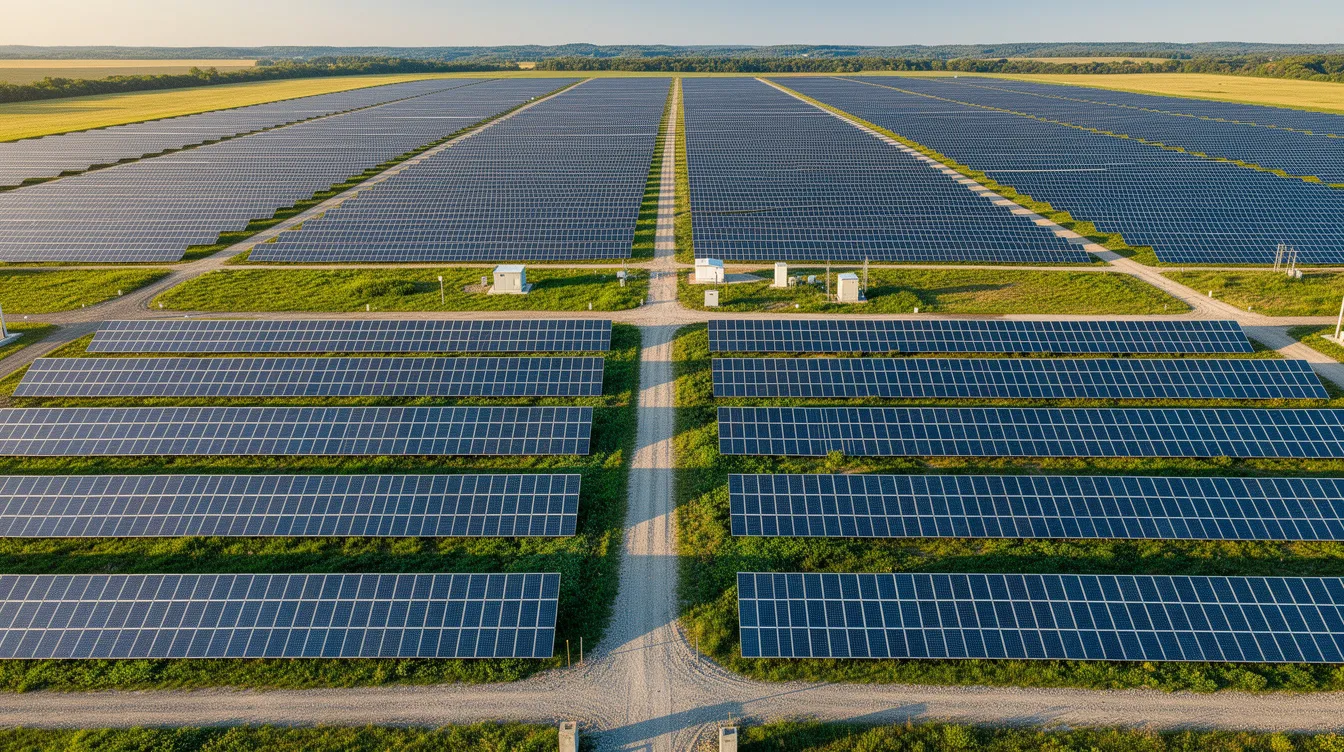
Walking through a typical solar farm, you’d see rows of panels oriented to capture maximum sunlight, mounted on fixed-tilt racking at angles between 10-35 degrees. Gravel access tracks allow maintenance vehicles through. Central inverter stations convert dc electricity to AC, while step-up transformers boost voltage for grid connection. Perimeter fencing with CCTV provides security, and increasingly, sheep graze underneath panels as part of agrivoltaic practices that maintain vegetation naturally.
Real-world examples illustrate the scale. The UK’s 49.9MW Cropredy Solar Park in Oxfordshire (commissioned 2021) generates enough electricity to power approximately 15,000 homes. Spain’s 500MW Escatrón project (2023) ranks among Europe’s largest. India’s 2.25GW Pavagada Solar Park in Karnataka (2018) is the world’s second-largest, while China’s 2.2GW Gonghe Solar Park in Qinghai (2024) demonstrates the enormous scale now possible.
From the panels, DC aggregates at 1500V strings to inverters, which output AC stepped up to grid voltage via transformers with under 2% losses. Electricity generated travels through medium-voltage cabling to substations, then onto 11-33kV distribution or 132kV+ transmission lines feeding the wider grid.
Single-axis trackers that rotate panels east-west throughout the day boost yields by 15-25% in high-irradiance areas. Dual-axis trackers can increase output by up to 40%, though they add 20-30% to installation costs. Fixed-tilt systems remain common where economics favour simplicity.
Can solar power generate electricity on cloudy days?
One persistent myth suggests solar panels don’t work when it’s cloudy. In reality, panels generate electricity whenever it’s daylight, regardless of whether the sun shines directly or hides behind clouds.
Output correlates with irradiance (measured in watts per square metre) rather than direct beam sunlight alone. Diffuse light scattered by clouds still contains energy that pv cells can convert. Under full sun at 1000 W/m², a panel operates at peak capacity. A heavily overcast day might deliver 100-200 W/m², yielding 10-20% of maximum output. Less than ideal, certainly, but far from zero.
Countries with reputations for grey skies have built substantial solar fleets. Germany, with approximately 900 kWh/m²/year irradiance (cloudier than California), hosts over 80GW of solar capacity as of 2024. UK systems average 850-1000 kWh/kWp annually despite frequent cloud cover, proving that solar technologies perform viably even in northern European climates.
Several factors affect energy yield beyond weather. South-facing panels at approximately 30-degree tilt optimise capture in the UK, while east or west orientation reduces output by 10-20%. Shading from trees, chimneys, or neighbouring buildings can significantly impact production, though bypass diodes in modern panels minimise losses from partial shading. Panel efficiency actually peaks at cooler temperatures, with performance dropping 0.4-0.5% for every degree Celsius above 25°C, meaning mild UK winters can enhance relative output compared to hot summer days.
Pairing solar with battery storage addresses variability. A 5-10 kWh lithium battery stores daytime excess for evening use, enabling 70-90% self-sufficiency for many households. This stored energy bridges the gap between peak solar generation and peak household demand.
History: from early discoveries to modern solar electricity
Humans have harnessed sunlight for millennia, but converting it directly into electricity required scientific breakthroughs spanning centuries.
Ancient civilisations understood the sun’s power. As early as the 7th century BC, Greeks used magnifying lenses to concentrate sunlight and start fires. But the journey toward modern solar electricity began in 1839 when 19-year-old French physicist Edmond Becquerel discovered the photovoltaic effect while experimenting with electrolytic cells. He observed that certain materials produced small amounts of electric current when exposed to light.
The 1880s brought practical progress. Scientists created the first solar cell using selenium, achieving roughly 1% efficiency. In 1884, American inventor Charles Fritts installed a selenium-based rooftop solar array in New York, marking an early milestone in rooftop installations. These early cells were far too expensive and inefficient for practical power generation, but they proved the concept worked.
The true breakthrough came in 1954 when Bell Labs developed the first practical silicon solar cell, achieving 6% efficiency. Though initially priced at an eye-watering $300 per watt, this technology proved ideal for space applications. Vanguard 1 satellite, launched in 1958 with 0.1W cells, remained operational for seven years. Throughout the 1960s, NASA missions relied heavily on solar cells to power spacecraft beyond Earth’s atmosphere.
The oil crises of 1973 and 1979 sparked renewed interest in terrestrial applications. Prices fell from $20/W in the 1970s to under $1/W by 2010 as manufacturing scaled up, increasingly dominated by Chinese production (over 80% of global output by 2024). Global capacity exploded: 1GW in 1989, 100GW in 2012, 1 terawatt in 2022, and 1.6TW by 2024. Annual additions now exceed 400GW, transforming solar from a curiosity into a cornerstone of global power stations.
Global solar power: who generates the most electricity?
Solar electricity generation has become a major contributor to national energy supplies across multiple continents. By the mid-2020s, several countries had built enormous capacities, fundamentally reshaping their electricity supply portfolios.
China leads decisively, generating approximately 500 TWh of solar electricity in 2024 (over 8% of its total electricity) from roughly 630GW of installed capacity. The United States follows with around 170 TWh from 180GW. Japan produces approximately 100 TWh from 90GW, while Germany generates 60 TWh from 80GW. India has rapidly scaled to 100 TWh from 100GW of capacity, with ambitious expansion plans continuing.
Globally, solar hit 7% of electricity generation in 2024 (roughly 1,600 TWh), growing at approximately 25% annually. This growth rate outpaces most other renewable energy sources and continues accelerating as costs decline further.
Why do so many nations pursue solar so aggressively? Energy security ranks high, as solar reduces dependence on imported fossil fuels and volatile commodity markets. Emissions reduction matters increasingly as climate commitments tighten. Economic factors also drive adoption, with solar now cost-competitive with or cheaper than new coal or gas plants in most regions. These rankings shift constantly as new large-scale projects complete, particularly in sunnier developing nations building out infrastructure rapidly.
Bringing more solar electricity into national grids
Governments worldwide are planning major increases in solar capacity as part of efforts to decarbonise electricity systems by the 2030s and 2040s. These plans involve coordinated strategies spanning policy, infrastructure, and technology.
Three main deployment pathways drive expansion. Rooftop PV programmes encourage homeowners and businesses to install solar panels on existing buildings, often with financial incentives. Utility-scale solar farms deliver bulk generation through dedicated projects on suitable land. Community solar schemes enable renters and those without suitable roofs to benefit from shared installations.
Policy mechanisms vary but share common goals. Feed-in tariffs guarantee fixed payments for every kWh exported to the grid. Contracts for difference (CfD) provide price certainty through competitive auctions, with UK rounds clearing at £40-50/MWh. Tax credits like the US Investment Tax Credit (30% through 2032) reduce upfront costs. Export payment schemes such as the smart export guarantee reward surplus generation fed back to power lines.
Grid operators face significant modernisation challenges. More variable generation requires smarter controls, expanded battery storage (with 100GW+ targets globally), high-voltage DC interconnectors between regions, and demand response programmes. Balancing supply and demand becomes more complex but also more sophisticated with digital technologies.
Solar electricity in the UK
The UK’s solar trajectory has evolved from early residential adoption in the 2010s (driven by generous feed-in tariffs that installed roughly 10GW) to recent utility-scale projects connected directly to the transmission grid. By 2024, total capacity reached 15.5GW, supplying approximately 5% of UK electricity.
A concrete example: the 400MW Barnsley Solar project near Bristol (commissioned 2023) generates roughly 400 GWh annually, enough to power approximately 115,000 homes. Such transmission-connected solar farms increasingly complement the distributed rooftop fleet across the country.
The UK government targets 70GW of installed solar capacity by 2035, roughly a five-fold increase from early-2020s levels. Achieving this requires sustained policy support through the smart export guarantee (paying £0.05-0.16/kWh for exports), planning reforms to accelerate project approvals, and renewable auctions (CfD Allocation Round 6 awarded 5GW of solar capacity).
Despite the UK’s reputation for grey skies, solar performs respectably at 900-1100 kWh/kWp annually. Both rooftop installations on homes and businesses and large solar farms will play crucial roles in meeting these targets.
Solar electricity in the United States
The US has established itself among the world’s top solar electricity producers, with strong growth since the early 2010s driving installed capacity to approximately 180GW by 2024, generating 6-7% of national electricity.
The 2021 Solar Futures Study from the National Renewable Energy Laboratory modelled scenarios where solar could supply around 40% of US electricity by 2035 under ambitious policy conditions. This would require continued rapid deployment of both utility-scale projects and rooftop systems.
The Inflation Reduction Act of 2022 provided substantial federal investment, extending the 30% Investment Tax Credit through 2032 and committing $370 billion to clean energy overall. Solar manufacturing hubs receiving over $7 billion in support launched in 2023 and beyond, aiming to rebuild domestic production capacity.
State-level policies have driven development across sun-rich regions. California leads with approximately 50GW of capacity providing 25% of state power. Texas has rapidly expanded to 20GW, with Arizona and other southwestern states following. Grid modernisation continues through FERC rules enabling more electricity generated from distributed sources, alongside storage and smart demand management integration.
Why is solar power considered clean and renewable?
Solar power produces electricity without burning fuel, meaning operational greenhouse gas emissions are essentially zero. No combustion occurs, so there are no particulates, nitrogen oxides, or sulphur dioxide released during solar generation.
Life-cycle analysis reveals a more complete picture. Manufacturing solar panels consumes energy and materials, with production typically generating 200-500 kg of CO₂ per kWp of capacity. However, panels “pay back” this carbon footprint within 1-3 years of operation at typical capacity factors, then generate clean electricity for 25-40 years while retaining 80% of original output. The IPCC estimates lifecycle emissions at approximately 41g CO₂/kWh, compared to coal at 820g/kWh.
Modern solar modules are increasingly designed for recycling at end of life. Recovery rates reach 95% for glass and aluminium, 90% for silicon. EU mandates target 80% recycling rates by 2030, driving development of dedicated recycling facilities and circular economy approaches.
Environmental considerations do exist. Large solar farms require 3-10 acres per MW of capacity, potentially competing with agriculture or natural habitats. Mitigation strategies include agrivoltaic practices (combining farming with panels), floating PV on reservoirs, and prioritising brownfield or degraded land. Site selection processes now routinely assess ecological impacts, minimising conflicts.
Compared with coal or gas power stations, solar has vastly lower emissions, no air pollution during generation, no ongoing fuel extraction impacts, and no water consumption for cooling. Wind power shares many of these advantages, making both key renewable energy sources for decarbonisation.
Advantages and disadvantages of generating electricity with solar
Solar energy generation offers compelling benefits but isn’t perfect for every situation. Understanding both sides helps readers make informed decisions about whether solar suits their circumstances.
The advantages stack up impressively. An infinite energy source arrives daily as the sun shines across earth’s surface. Operating costs run low (approximately $10/kW/year versus $30+ for coal). Homeowners with 4 kWp systems typically save £400-800 annually on electricity bills, with additional income possible from exporting surplus. Modularity means solar scales from 1kW portable systems to GW-scale farms. Integration with electric batteries and electric vehicles creates synergies that enhance overall value. Converting energy from sunlight requires no fuel purchases, hedging against volatile energy prices.
The disadvantages deserve honest acknowledgment. Solar power works only during daylight, with output varying by weather and season, meaning 20-50% backup or storage capacity is typically needed. Upfront capital costs remain significant (£1,000-1,500/kWp for residential systems), though prices have fallen 89% since 2010. Space requirements mean rooftops need 10-20 m²/kW of unshaded area, while ground-mounted farms compete for land. Some homeowners find panels aesthetically concerning. Recycling infrastructure remains immature, though improving rapidly.
A concrete domestic example illustrates the trade-offs. A typical 4 kWp UK home system cuts annual grid electricity use by roughly 3,500 kWh (saving approximately £1,000 at current £0.28/kWh rates), costs around £6,000 after available subsidies, and achieves payback in 6-8 years. However, the home needs an unshaded south facing roof with sufficient structural capacity. Solar optimisers or microinverters add cost but improve performance where partial shading exists.
Key concepts and terms in solar electricity
Understanding solar electricity requires familiarity with several technical terms that appear throughout discussions of the technology. This section clarifies the most important concepts.
A solar cell is the basic unit of solar generation, typically a square or rectangular piece of silicon (10-20 cm per side, weighing just 3-5 grams) that converts light into DC electricity via its internal p-n junction. These are sometimes called solar cells or photovoltaic cells interchangeably.
A solar module or solar panel assembles 60-72 individual cells into a framed unit measuring approximately 1.6-2 m² and producing 300-450W. Multiple panels connected together form a solar array, the complete generating system visible on a roof or in a field.
Kilowatt peak (kWp) rates the maximum output of a solar system under standard test conditions (1000 W/m² irradiance, 25°C cell temperature). A 4 kWp system can theoretically produce 4 kW at its peak. Kilowatt hour (kWh) measures actual energy produced or consumed, the unit appearing on electricity bills (UK average home uses approximately 4,200 kWh yearly).
Direct current flows continuously in one direction, as produced by solar panels. Alternating current oscillates direction 50 or 60 times per second, the standard for power lines and home wiring because transformers can easily change AC voltage for efficient transmission.
An inverter converts DC from panels to AC for grid connection and household use. Grid-connected systems tie to utility power lines, allowing electricity export and backup supply. Off-grid solar systems rely entirely on battery storage and possibly generators for remote locations without grid access.
Self-consumption refers to using solar generation directly rather than exporting it, typically prioritised because electricity bills charge more electricity per kWh than export schemes pay. Optimising self-consumption (achieving 70-90% with smart controls and batteries) maximises financial returns from residential solar systems.
Solar power generate electricity through remarkably elegant physics that humanity has refined over nearly two centuries. From Becquerel’s 1839 observations to today’s 1.6 terawatt global fleet, solar has transformed from laboratory curiosity to essential infrastructure. Whether you’re considering panels for your roof or simply curious about how that clean energy reaches your sockets, understanding the technology empowers better decisions about our collective energy future.