With the UK Government’s deadline for rental properties to achieve a minimum Energy Performance Certificate (EPC) rating of ‘C’ set for 1st October 2030—backed by potential fines of up to £30,000—the race is on for landlords to ensure compliance
Recent research reveals two-thirds (67%) of landlords are currently unaware of the EPC ‘C’ requirements, and 73% do not know when the deadline is.
That is why we are thrilled to announce our collaboration with The Mortgage Works, a leading UK buy to let lender, to launch a groundbreaking pilot support package to remove the uncertainty and financial barriers around retrofitting.
A Complete Solution: Free Assessments & Discounted Funding
We will deliver 1,000 fully funded property assessments for eligible The Mortgage Works landlords.
- The assessments will give landlords:
- Clarity of how far their properties are from an EPC ‘C’ rating.
- Practical recommendations and estimated costs to get compliant.
- Guidance on exemptions or exceptions.
- End-to-end support, offering retrofit installations.
The Mortgage Works is also rolling out new, discounted Energy Efficiency Further Advance products, providing up to £15,000 in low-rate financing to help cover the costs of upgrades.
Delivering Quality with a Resident-First Approach
Retrofitting not only upgrades the living standards of residents it also enhances asset values for property owners. Data shows energy-efficient homes command higher property values and better rental yields, all while keeping energy bills more affordable for tenants.
Speaking on the launch of the collaboration, Lee Rix, Managing Director of Eco Approach:
“We are proud to be working with The Mortgage Works on this important initiative, helping landlords understand the improvements needed across their properties and giving them a clear, practical route to action. Combining discounted lending products with Eco Approach’s retrofit expertise means landlords can rest assured that high-quality installations, underwritten by insurance-backed guarantees, will assure compliance with the new legislation.”
“Our resident-first approach is designed to make the journey smooth and informed for landlords and tenants alike, supporting better property performance and homes that are warmer, healthier and more affordable to run.”
Why Landlords Need to Act Today
Waiting until 2030 may lead to supply chain bottlenecks, increased material costs, and a rush for qualified retrofit specialists. By tackling energy efficiency upgrades now, landlords can protect their portfolios early, enjoy premium rental yields, and ensure their tenants are living in warm, healthy, and energy-efficient environments.
If you’re a landlord looking to plan your property’s journey to an EPC C, get in touch with our team today.

Frequently asked questions
What is a MEES Report?
The MEES Report is an in-home assessment by a trained energy assessor and lasts approximately 30 to 45 minutes. Once completed you will be issued a report with a quote where we guarantee reaching compliance.
Can I check my property online first before an in-home assessment?
We have an online tool where you can check whether you are currently compliant here: ecoapproach.greenval.co.uk
However, this online report is a guide only and we do not guarantee compliance based on this. You can order an in-home assessment at the end of this online report.
Why should I act now?
There are distinct strategic advantages and risks to acting now versus delaying.
We are happy to talk through this with you, but if in doubt, do get a separate opinion.
Generally, if your property can reach a Band C under the current system within the £10,000 cap, we strongly advise instructing the works immediately to lock in compliance under the “Grandfathering” rule.
However, if your property cannot reach a C within the cap, or if you believe it may qualify for a “Low Value” or “Solid Wall” exemption in the future, it may be prudent to wait until the legislation is finalised.
See here for the latest information: https://ecoapproach.co.uk/mees/
What are the key dates?
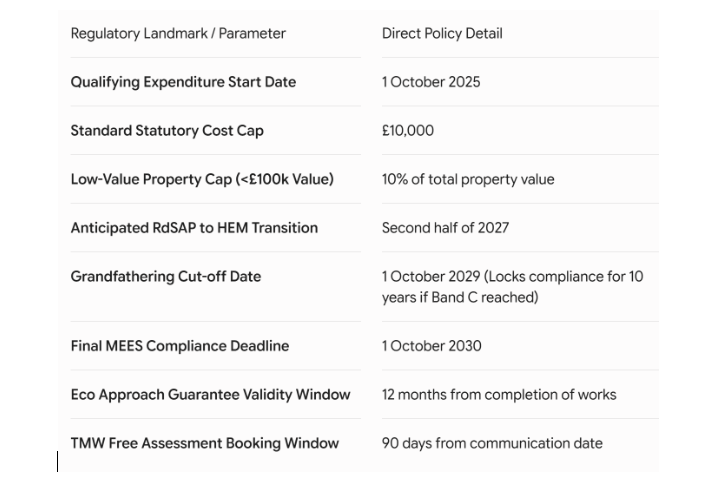
A strict deadline of 1 October 2030 has been set.
By this date, all privately rented properties (including both existing and new tenancies) must meet the minimum energy efficiency standard of a Band C or have a valid exemption registered.
Failure to comply means you will not be able to continue letting the property and may face financial penalties and limited mortgage options. The table below summarises the key dates.
Has the legislation been officially passed?
While the new MEES regulations have been formally confirmed in the Government’s response to the Warm Homes Plan (Jan 2026), the specific legislation has yet to be laid before Parliament. However, the policy direction is fully set for long-term planning.
For the latest updates see here: https://ecoapproach.co.uk/mees/
What is the new "Dual Metric" standard?
Moving away from the single cost-based Energy Efficiency Rating (EER), the post-EPC reform standard requires properties to pass two separate checks under the Home Energy Model (HEM):
Metric A: Fabric Performance (Mandatory): The property must meet a non-negotiable minimum standard for heat retention, such as adequate insulation and double glazing.
Metric B: Secondary Measure (Landlord’s Choice): Once fabric targets are met, landlords must either install a low-carbon heating system (e.g., a heat pump) or implement smart readiness technologies (e.g., solar PV, battery storage, or smart meters).
For the latest updates see here: https://ecoapproach.co.uk/mees/
What is the "Grandfathering" rule?
To manage the transition, existing EPCs will be fully honoured. Any property that secures a Band C or higher under the current RdSAP methodology before 1 October 2029 will remain legally compliant until that specific EPC expires (which is valid for 10 years).
For the latest updates, see here: https://ecoapproach.co.uk/mees/
How much am I required to spend to upgrade my property?
The standard Statutory Cost Cap has been raised to £10,000 per property (up from the previous £3,500) factoring in any qualifying expenditure incurred from 1 October 2025 onwards.
For the latest updates see here: https://ecoapproach.co.uk/mees/
What happens if my property still isn't compliant after spending £10,000?
If the property remains non-compliant after you have exhausted the £10,000 spending limit, you can register a valid statutory exemption.
Are there any special exemptions for lower-value properties or specific walls?
Yes, the new framework includes targeted exemptions:
Low-Value Property Cap: For properties valued under £100,000, the compliance cost cap is reduced to 10% of the property value.
Solid Wall Insulation: Landlords retain the choice to skip installing solid wall insulation if they deem it too disruptive, provided they meet alternative requirements or register a specific exemption.
For the latest updates, see here: https://ecoapproach.co.uk/mees/
What exactly does the Eco Approach MEES Guarantee cover?
When you commission Eco Approach Ltd to handle a MEES Report, an in-home energy assessment, and all recommended improvement works, the company guarantees your property will either achieve the required regulatory standard or qualify for a legally registered exemption. This Guarantee is valid for 12 months from the date the works are completed.
Please see our terms and conditions here: https://ecoapproach.co.uk/mees-terms-and-conditions/