The Home Energy Model for existing homes, known as HEMIE, has moved from consultation to implementation. Last week, Elmhurst Energy received the finalised methodology schema for the next generation of domestic EPCs.
Software providers and accreditation schemes can start building the tools, training and guidance for assessors when RdSAP ends. We spoke to Joe, our Compliance & Certification Manager about the news.
“The finalised HEM schema is a welcome step towards more accurate EPCs, and we’re optimistic about the benefits it could bring. We look forward to more detail on how it will affect the survey process and customer advice. Upskilling the existing assessor base will be vital to a seamless transition for customers and business clients alike“
— Joe Brennan, Compliance & Certification Manager, EcoApproach
How the Home Energy Model works
HEM is the Government’s replacement for both SAP, used for new-build compliance, and RdSAP, used for EPCs on existing homes. As a physics-based simulation, and not a set of monthly averages, it changes how homes are assessed in three ways.
- It calculates every half hour. HEM models energy demand and system performance in 30-minute steps across the year. It gives a better picture of technologies whose value depends on timing, such as heat pumps, solar PV, batteries and smart controls.
- The engine is held centrally. Under SAP, accreditation schemes and software houses built their own calculation engines to an agreed specification. With HEM, the core engine is controlled by Government and delivered as a service, so every assessment runs on the same calculation.
- Software connects through “wrappers”. Each use case, such as Future Homes Standard compliance or producing an EPC, has its own wrapper that defines exactly which inputs go in and which results come out. HEMIE is, in effect, the specification for the existing-homes EPC route.
What the November schema confirms for existing homes
Site surveys are kept practical, but the model behind them is richer. Assessors enter what they can verify. The engine then fills gaps with standard defaults, inferred values and automatically generated geometry.
Changes from RdSAP are:
- Fabric beyond age bands. Walls, roofs and floors can be described by documented U-values (U-values measure the rate of heat transfer through a building element such as a wall, floor, roof, window, or door), simple construction types or full layer-by-layer build-ups, with better treatment of thermal mass and thermal bridging.
- Richer geometry and shading. Each element can carry its own orientation, pitch and size, and shading from nearby buildings, trees, balconies and overhangs is modelled.
- Wider heating and hot water coverage. Heat batteries, heat networks, smart hot water tanks and advanced controls are covered, along with emitter type and size, buffer tanks and pipework.
- Smart tech and renewables. More detail on solar PV and inverters, plus batteries, PV diverters and any grid import or export limits.
- Overheating and cooling. Window opening, shading, air permeability and trickle vents feed into summer performance, and air conditioning or cooling heat pumps are modelled from performance data.
- Appliances, recorded by the assessor. Dishwasher, clothes drying, a separate fridge or freezer, and oven and hob fuel are noted; everything else, including lighting, comes from standard profiles.
- Room for measured data. Heat Transfer Coefficient results from approved SMETER tests can sit alongside modelled values.
Elmhurst expects the data assessors collect to stay about the same. Its technical team is still checking whether any extra inputs will be needed on routine jobs.
When HEM arrives: new builds and existing homes
HEM rolls out on two separate tracks, with no go-live date for either or the model itself yet.
|
Track |
Replaces |
Currently |
|---|---|---|
|
New-build homes |
SAP 10.2 |
The Future Homes Standard comes into force on 24 March 2027 with SAP 10.3 as the only approved method. HEM’s launch was delayed on 8 June 2026 for final assurance and is now due “in the coming months”. Once approved, SAP 10.3 and HEM will run side by side for at least 24 months. |
|
Existing homes (EPCs) |
RdSAP |
Reformed, HEM-based EPCs are due in the second half of 2027 with HEMIE the methodology. |
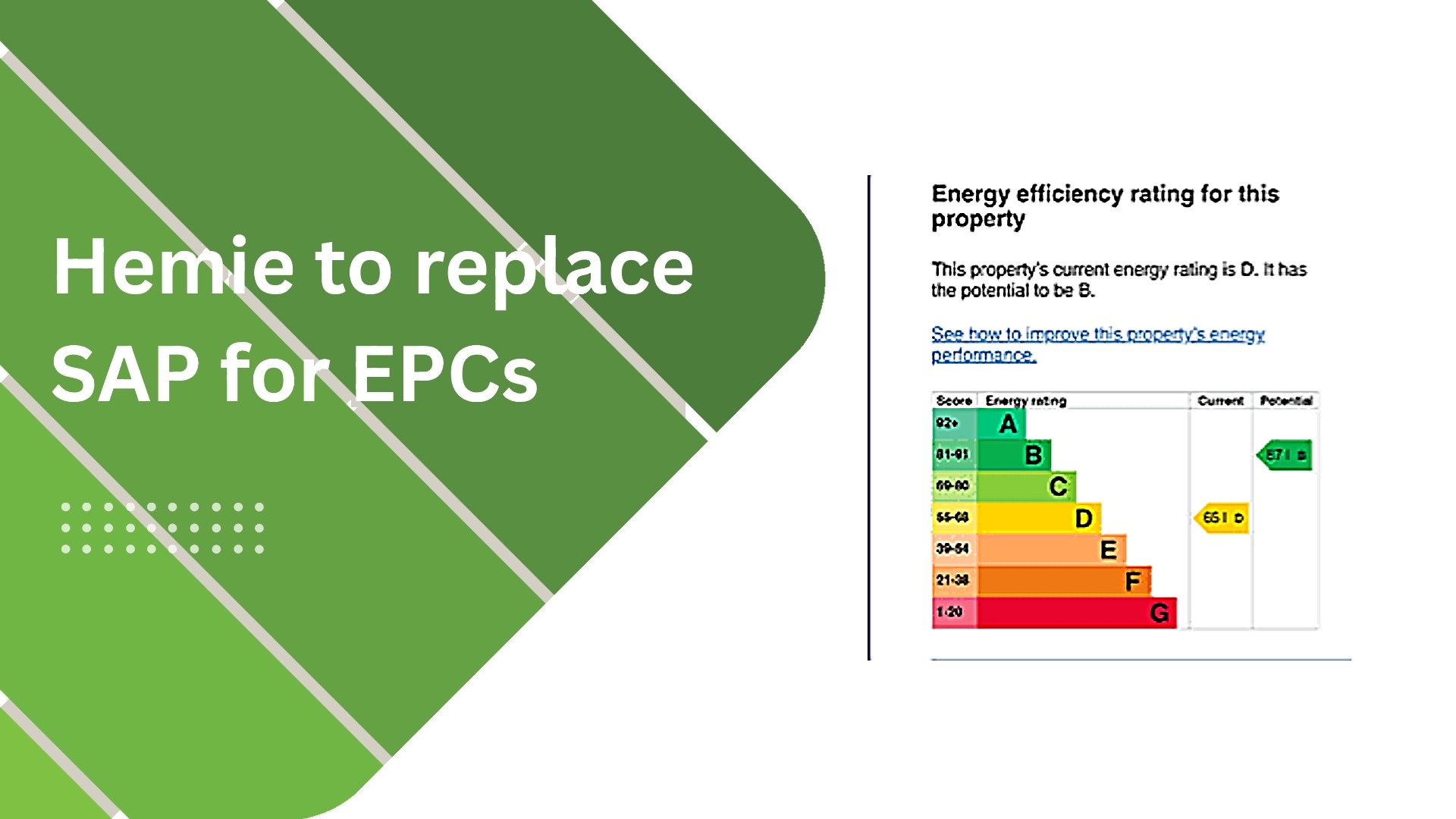
The reformed EPCs will swap today’s single rating for four headline metrics:
- fabric performance (A to G)
- heating system (A to G)
- smart readiness (A to G)
- estimated annual energy cost in pounds
Under the planned MEES rules, private rented homes will need a C on fabric performance and a C on either heating system or smart readiness by 1 October 2030.
How Elmhurst is preparing
Elmhurst is one of the UK’s largest accreditation schemes and sits between the Government’s central engine and assessors using it. Its preparations fall into three areas.
Software. Elmhurst is building Design HEM, a compliance tool that connects to the central engine. It is designed to carry data across from SAP projects so assessors don’t have to re-enter inputs.
Methodology review. Its technical team are reviewing how defaults, inferred values and automated geometry will apply on real surveys.
Training and guidance. HEM training is being developed for both On Construction and Domestic Energy Assessors.
Landlords and homeowners don’t need to act on HEMIE directly. Existing EPCs stay valid until they expire, but anyone planning upgrades should keep the four new metrics and the 2030 rental target in mind.